Product & Technology
The Complete Guide to LLM Evaluations
Part III - The Strategy & Implementation Guide
Practical implementation guide: use case strategies, step-by-step instructions for building your first eval, common mistakes to avoid, tool selection (build vs. frameworks vs. hosted), and a 90-day rollout roadmap.
About This Series
This guide is divided into three parts to take you from concept to production-grade implementation.
The Foundations
Focus: Buying vs. Building, Model Selection (MMLU/GSM8K), and Safety Checks.
Best for: Decision-makers establishing their AI stack.
The Cognitive Engine
Focus: Advanced RAG Evaluation (Context/Faithfulness) and LLM-as-a-Judge.
Best for: Engineers, Data Scientists, Product Managers building the AI Agents.
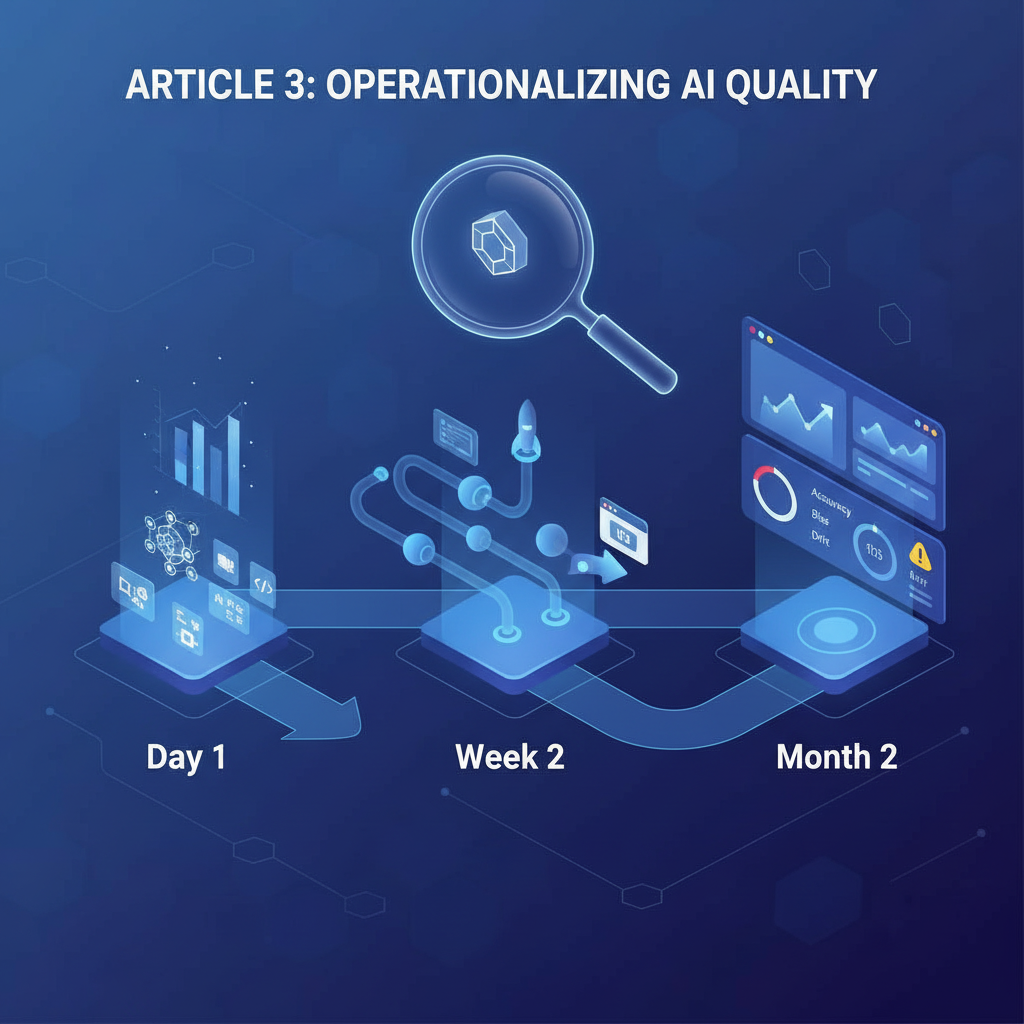
Operationalizing AI Quality
You are hereFocus: Strategy by Use Case, Hands-on Implementation and Tooling.
Best for: Tech Leads and Product Leaders managing production AI.
1. Implementation Strategy by Use Case
Now you understand what each eval does. Here's which ones to actually run based on what you're building.1.1. Use Case 1: Product Discovery Agent
Mission: Hook users with personalized product recommendations.
1.1. Key Evals
- Deterministic: Does recommendation include product ID? (JSON validation)
- Deterministic: Is recommendation within 500 characters? (Engagement hook must be snappy)
- LLM Judge: Is the recommendation relevant to the user's stated need?
1.2. Evals to Skip
- Faithfulness (You're not summarizing docs, you're matching patterns)
- Context Relevance (Recommendation isn't based on retrieved documents)
- MMLU score (Doesn't matter if model knows history; matters if it matches products to needs)
Why: Discovery is about engagement and relevance, not accuracy. Simple checks + quick LLM scoring.
1.2. Use Case 2: Product Research Agent (Assistant)
Mission: Answer customer questions about products accurately.
2.1. Key Evals
- Context Relevance: Did retrieval find docs about this product?
- Faithfulness: Did LLM stick to the product manual (critical!)
- Answer Relevance: Did it answer this specific question?
- LLM Judge (Custom): Is the tone friendly?
2.2. Evals to Skip
- Creativity metrics (You want boring, accurate facts, not creative content)
- MMLU (Doesn't measure whether it knows your products)
- Verbosity isn't bad here (customers like detailed product info)
Why: Customers are reading product details. Trust is everything. Every claim must be verifiable.
1.3. Use Case 3: Sales Reachout Agent (Analyst)
Mission: Analyze chat interactions and score purchase intent 1-100.
3.1. Key Evals
- Deterministic: Does output JSON parse correctly? (CRM needs valid JSON)
- Deterministic: Is intent_score between 1-100?
- Custom Eval: Compare agent's intent score vs human labels on 50 chats (accuracy metric)
3.2. Evals to Skip
- Faithfulness (This isn't summarizing documents; it's analyzing signals)
- Chatbot Arena (This backend system doesn't chat with humans)
- Context Relevance (No document retrieval here)
Why: This agent is analytical, not conversational. What matters is structural correctness (JSON valid) and analytical accuracy (does intent score match human judgment).
2. How to Build Your First Eval (Hands-On Guide)
You've read all the types. Now: how do you actually implement one?
1.1. Step 1: Pick Your First Eval (Start Simple)
Don't try to evaluate everything. Pick one thing your system absolutely must do.
Examples:
- "Product name must appear in every response"
- "Sentiment score must be 1-10"
- "No competitor names"
2.2. Step 2: Gather 50 Real Examples
- Go into production logs (or user testing) and collect 50 actual inputs/outputs.
2.2.1. Format
- Input: "What's your return policy?"
- Output: "You can return within 30 days..."
- Expected: Should mention "30 days"
2.3. Step 3: Label Them Manually
Go through all 50 and decide what "correct" means.
Example for "Faithfulness":
- Document: "30-day return policy"
- Response: "You can return within 30 days"
- Label: ✓ FAITHFUL
- Response: "You can return within 60 days"
- Label: ✗ NOT FAITHFUL
2.4. Step 4: Write the Eval Logic
2.4.1. For deterministic evals
def eval_contains_product_name(response, product_name):
    if product_name.lower() in response.lower():
        return True
    else:
        return False
2.4.2. For LLM judges
prompt = f"""Check if this response mentions the return policy window.
Response: {response}
Document: {document}
Is the response faithful? Return "yes" or "no".
"""
score = judge_llm.generate(prompt)2.5. Step 5: Run the Eval on Your 50 Examples
- Count how many you got right.
- Target: 80%+ accuracy before deploying.
2.6. Step 6: Deploy and Monitor
- Every time your system runs, score 1-5% of outputs with your eval.
- Plot the score over time. If it drops, something's broken.
3. Common Mistakes & How to Avoid Them
3.1. Mistake 1: Over-Optimizing for Public Benchmarks
- The Problem: You read that GPT-4 scores 92% on MMLU and Claude scores 89%. You switch to Claude to save costs, but your app gets worse.
- Why: MMLU doesn't test what your app cares about. You optimized for the wrong metric.
- The Fix: Use MMLU only for initial model selection. After choosing a model, optimize for your evals.
3.2. Mistake 2: Judging with the Wrong Judge
- The Problem: You use a weak judge (like GPT-3.5) to evaluate your system, and it gives inaccurate grades.
- The Fix:
- Use a capable judge (GPT-4, Claude 3.5)
- Or combine multiple judges and vote
- Validate the judge against human labels before trusting it
3.3. Mistake 3: Eval Isn't Catching Real Problems
- The Problem: Your eval says "all responses are helpful" but customers complain they're useless.
- Why: Your eval is wrong or incomplete.
- The Fix: Sample 10 random responses and have a human read them. If humans disagree with your eval, redesign it.
3.4. Mistake 4: Running Too Many Evals
- The Problem: You're running 20 different evaluations. It takes 10 minutes per response. Your system becomes slow.
- The Fix:
- Start with 2-3 critical evals
- Add more only if problems emerge
- Run expensive evals (LLM judges) only on a sample (e.g., 5% of traffic)
- Run cheap evals (regex, JSON) on 100%
3.5. Mistake 5: Static Evals Don't Adapt
- The Problem: You built an eval 6 months ago. Your system evolved. The eval is now measuring the wrong things.
- The Fix: Review your evals quarterly. Update them based on:
- New failure patterns you've seen
- User feedback
- Business priorities changing
4. Choosing Tools
You can build evals yourself, or use existing frameworks.
4.1. Option 1: Build It Yourself
# JSON validation
import json
try:
    data = json.loads(response)
    assert data["score"] >= 1 and data["score"] <= 100
    print("PASS")
except:
print("FAIL")- Pros: Full control, no external dependencies, free.
- Cons: You have to write everything from scratch.
4.2. Option 2: Use Open-Source Frameworks
4.2.1. DeepEval (Python)
- Pre-built RAG evals (faithfulness, relevance, etc.)
- LLM judge templates
- Easy to customize
4.2.2. Ragas (Python)
- Specifically for RAG systems
- Automatic eval without manual labeling
- Good defaults
4.2.3. Promptfoo (JavaScript, Cloud)
- Configuration-based (no code)
- Great for A/B testing prompts
- Good visualization
4.3. Option 3: Use Hosted Platforms
4.3.1. Evidently Cloud
- Run evals without building infrastructure
- Built-in dashboards
- Integrates with CI/CD
4.3.2. LangSmith (by LangChain)
- Evaluation + monitoring
- Works with LangChain applications
- Hosted solution
5. Conclusion: Your Eval Strategy
Here's a simple rollout plan you can actually execute:
Your 90-Day Eval Implementation Roadmap
D1 Day 1: Choose your model
Run public benchmarks once (MMLU + Chatbot Arena if conversational). Pick your foundation model.
D2 Day 2–3: Gather real data
Collect ~50 real examples from your app and label what "correct" looks like.
W1 Week 1: Build your first eval
Start simple: JSON validation or keyword rules. Run on your 50 examples (target ~80%+ accuracy).
W2 Week 2: Deploy & monitor
Run on ~5% of production traffic. Track the score over time and alert on drops.
M2 Month 2: Add RAG evals (if applicable)
If you use retrieval, add faithfulness + relevance checks to reduce hallucinations.
M3 Month 3: Optimize & scale
Add pairwise comparison for prompt iteration. Review human feedback and refine criteria.
Golden Rule: Don't build the perfect eval system. Build the simplest eval system that catches the most important failures. You can always add more later.
The best eval is the one you actually use.