Voice AI
The Conversion Problem Isn’t Traffic. It’s Conversation.
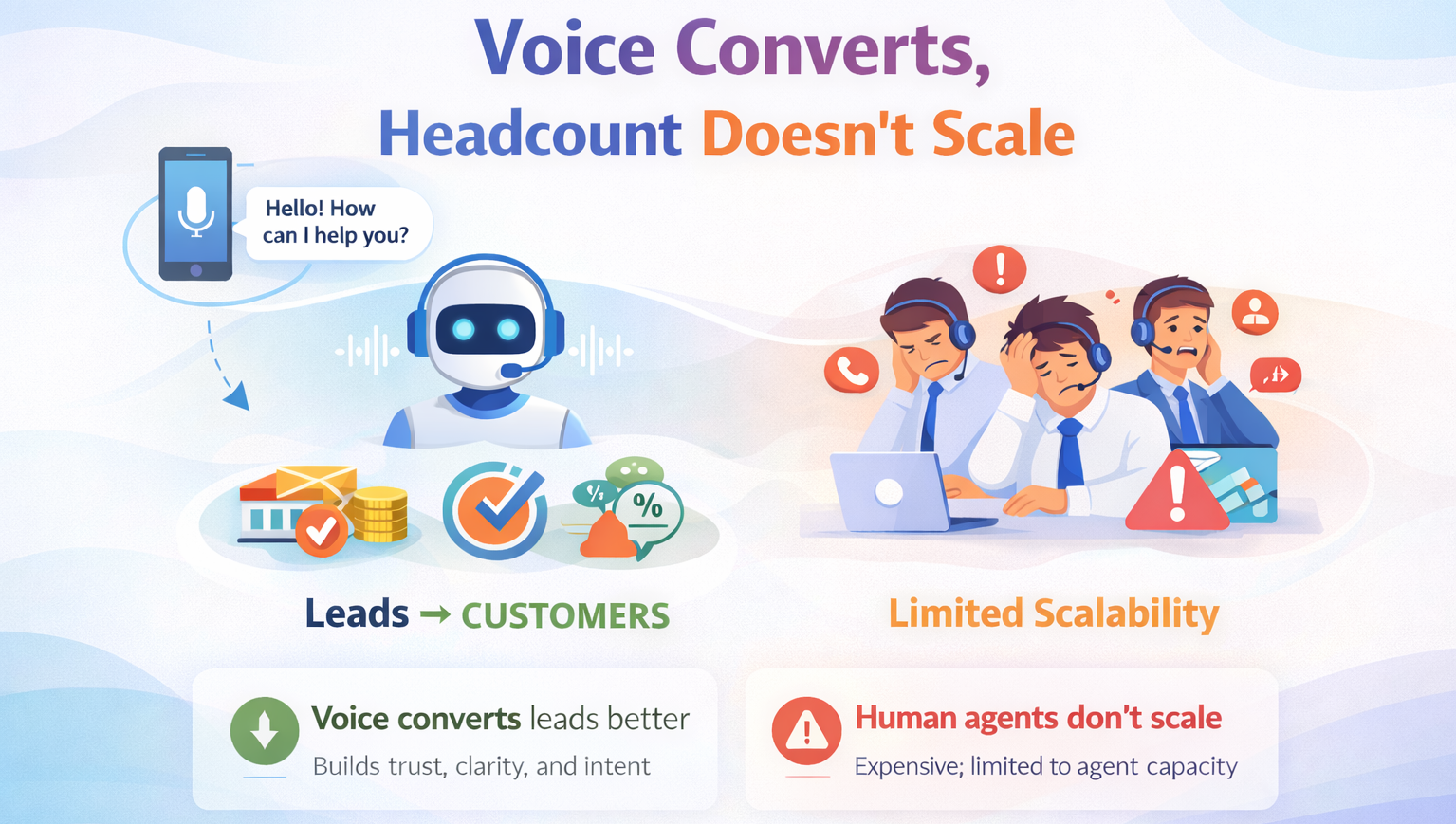
Voice is often the best-converting channel. The bottleneck is not voice itself, but delivering it through fixed headcount.
Why the Highest-Performing Channel Breaks as You Grow, and How to Fix It
Voice clearly outperforms static FAQs and one-way messaging but the economics of delivering high-quality, multilingual voice at scale are stacked against most businesses.
What starts as your best-performing channel often becomes your least scalable one.
Who is this for?
Mid-sized, customer-facing businesses handling high-intent interactions across:
- Sales
- Onboarding
- Support
Especially in multi-language or multi-region environments.
Why voice matters across industries
Voice is the most effective way to handle complex customer needs.
- Choosing a financial product
- Understanding a SaaS Product
- Deciding on a course
- Resolving a travel issue
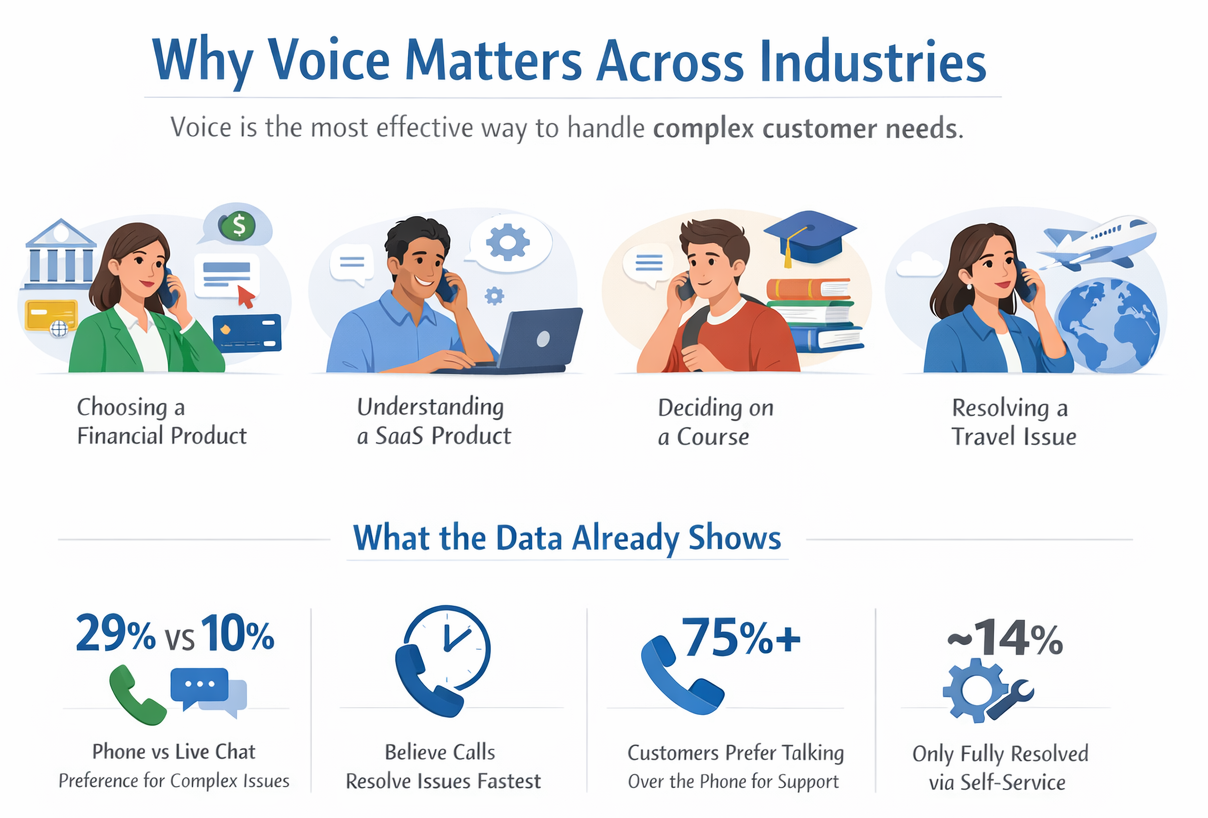
What the Data Already Shows
- 29% vs 10% -> Phone vs live chat preference for complex issues (benchmark study)
- 54% believe calls resolve issues fastest (McKinsey)
- 75%+ customers prefer talking over the phone for support (Five9 Study)
- Only ~14% of journeys are fully resolved via self-service (Gartner style research)
- 4-6 minutes -> typical handle time for complex interactions
Whether it is lending, SaaS onboarding, healthcare, insurance or logistics, when customers can “talk it through” they gain clarity, trust, and intent to proceed.
Why Human Voice Agents Breaks at Scale?
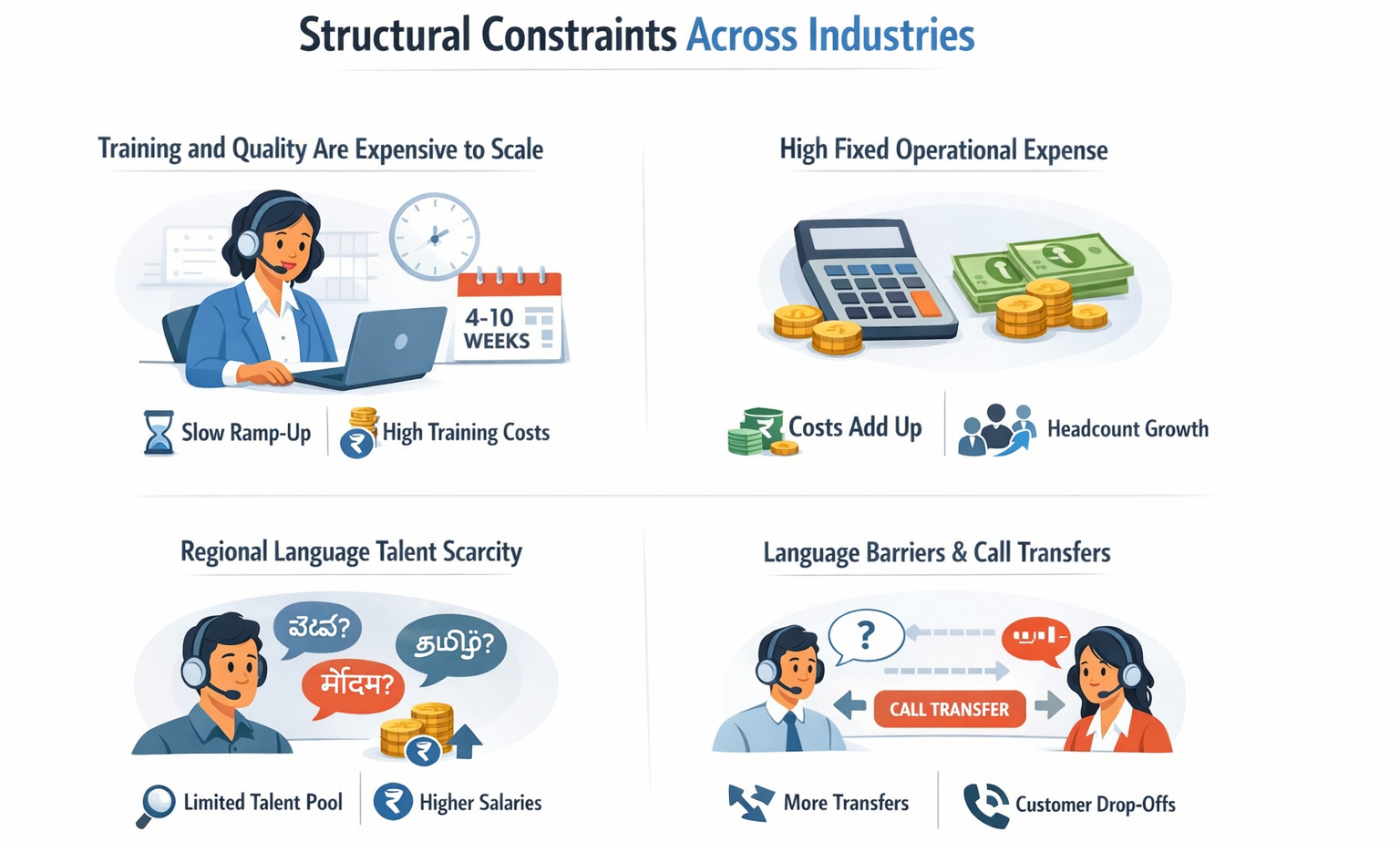
These constraints show up in banks/NBFCs, Insurance, SaaS, D2C, healthcare, and more.
1. Training and Quality Are Expensive to Scale
- Call-center Onboarding for Tier‑1 agents in complex environments (like financial services, healthcare, tech support) needs 120–300+ hours of training, plus ongoing annual refresh. (Link)
- Another study estimates 4-10 weeks from hiring to "floor ready", with 4-6 months before some reps become consistently proficient.
- Managers themselves only have a small slice of time available for deep training and coaching; one study notes customer service leaders are heavily constrained on time for agent development
Effect
- Weeks-to-months ramp-up for every new agent
- High training cost and inconsistent customer experience at scale
- Inconsistent or outdated communication across customers
2. High fixed operational expense
- A dedicated agent costs roughly ₹25,000–₹60,000 per month in domestic operations. (study)
- Typical inbound voice operations in financial services see 4-6 minute average handle time per call, so you cannot simply "compress" time to fit more calls without hurting quality.
Effect
- Costs remain fixed regardless of demand fluctuations
- Scaling requires adding headcount, not improving efficiency
3. Scarcity and premium cost of regional language talent
- In India, voice in regional languages (Kannada, Marathi, Tamil, etc.) is a key differentiator, but good agents in these languages are limited and command higher salaries.(study)
- Bilingual agents earning around ₹41,000/month on average, significantly above entry-level monolingual roles. (Salary data)
Effect
- Limited ability to serve customers in their preferred language
- Higher cost structure due to dependence on multilingual agents
4. One agent = few languages -> transfers and drop-offs
- A typical human agent realistically handles one primary and maybe one secondary language at quality.
- When a customer calls speaking Kannada but lands with a Hindi/English agent, the call must be transferred, often to a limited pool of regional-language reps.
- Abandonment rates of 5-10% aeven before considering extra transfers and holds. (metrics)
Effect
- Increased transfers and wait times for customers
- Measurable drop-offs and abandonment in high-intent journeys
Voice works. But scaling it with people creates structural inefficiencies that compound as you grow.
Case study: Mid-Size Company before and after SpotInfo
Reality
- Voice drives higher conversions, but only a fraction of leads reach an agent.
- Regional borrowers expect Kannada, Marathi and other languages.
- Every product/ policy change requires fresh training, which lags reality by weeks.
Result: Voice is their best-performing channel for trust and conversion, but also the least scalable with their current cost structure.
This pattern is almost identical in:
- SaaS: inbound trials and demos wanting to "talk to someone" right now.
- Healthcare: patients and families needing to talk through procedures, billing and insurance.
- Insurance: policy buyers trying to decode coverage and exclusions.
- Education: users needing real-time, contextual support.
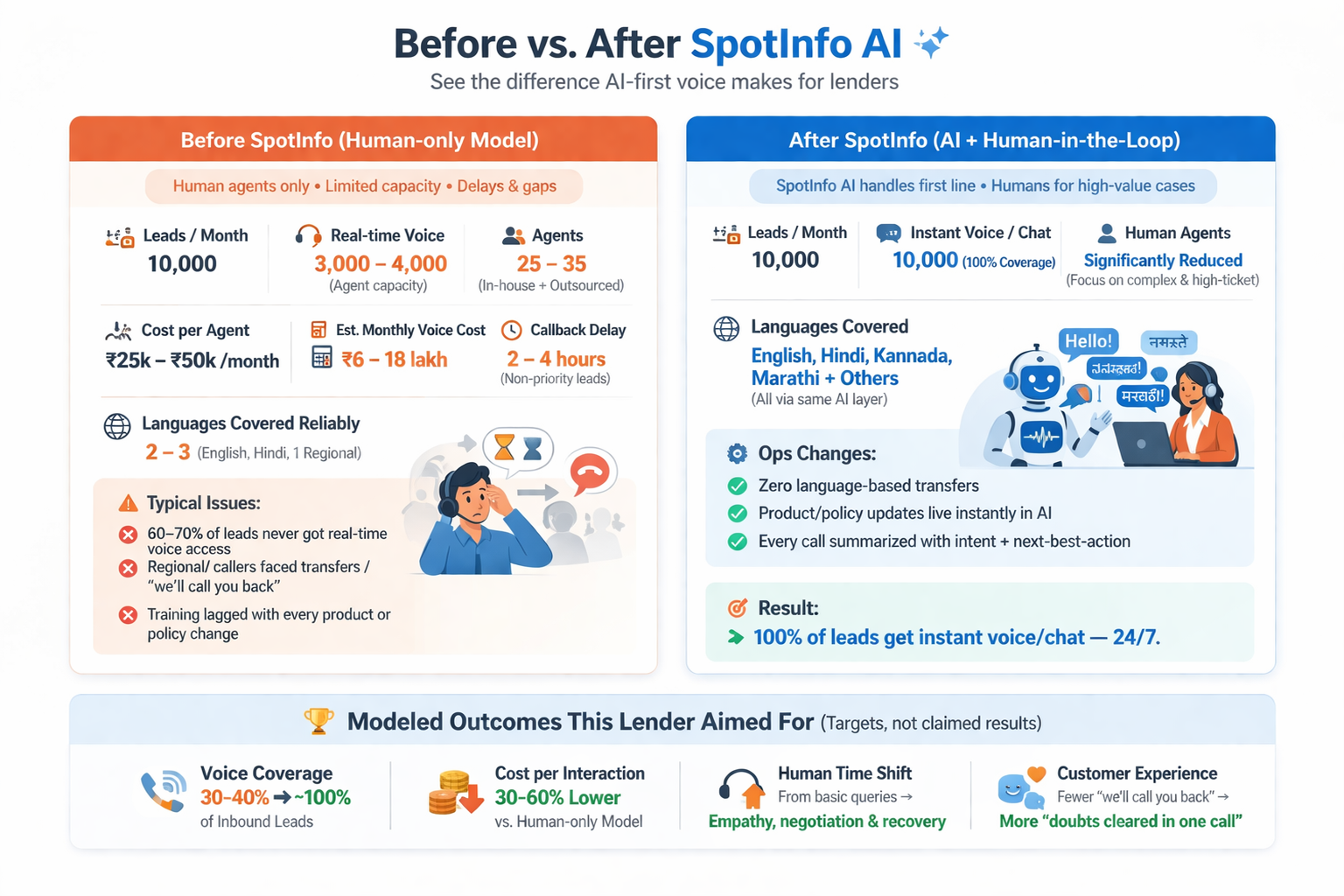
Before SpotInfo (Human-only model)
- Leads/month: 10,000
- Leads that got real-time voice: 3,000 - 4,000 (agent capacity)
- Agents: 25 - 35 (mix of in-house + outsourced)
- Cost per agent: INR 25k - INR 50k/month
- Estimated monthly voice cost: INR 6 - 18 lakh
- Callback delay: 2 - 4 hours for most non-priority leads
- Languages covered reliably: 2 - 3 (English, Hindi, one regional)
- Typical issues:
- 60-70% of leads never got real-time voice access
- Regional callers faced transfers / "we'll call you back"
- Training lagged every time products or policies changed
After SpotInfo (AI + human-in-the-loop)
SpotInfo became the first line of voice + chat, with humans focusing on high-value and complex cases.
- Leads/month: 10,000
- Leads that get instant voice/chat: 10,000 (100% coverage)
- Human agents: significantly reduced frontline dependency, focused on:
- complex cases
- high-ticket or at-risk customers
- Languages covered: English, Hindi, Kannada, Marathi and others via the same AI layer
- Ops changes:
- Zero language-based transfers
- Product/policy changes reflected instantaneously in conversations
- Every interaction summarised with intent + next-best-action
Modeled outcomes this lender aimed for
Without claiming realised numbers, the target state looked like:
- Voice coverage: 30-40% -> 100% of inbound leads
- Cost per interaction: 30-60% lower vs pure human-only model
- Human time: shifted to empathy, negotiation, and recovery
- CX: fewer delays, more resolved-in-one-call journeys
Where Human Voice Still Matters
AI handles the majority of structured, repeatable conversations,
while humans focus on empathy, judgment, and high-stakes interactions.
AI doesn’t replace humans, it reallocates them.
Human involvement is critical for:
- Sensitive or emotionally charged conversations: e.g., medical situations, financial distress, complaints
- Negotiation and exception handling: e.g., settlements, custom pricing, escalations
- High-value customer relationships where trust and continuity matter more than speed
- Edge cases outside defined workflows where judgment is required over rules
In practice, the most effective model is not AI vs human, but a hybrid system:
This shift allows businesses to use human time where it matters most, rather than on repetitive queries.
So far, the limitation has never been voice itself, it has been how voice is delivered.
What changes if voice is no longer constrained by headcount, language, or training cycles?
How SpotInfo scales "voice" without scaling headcount
SpotInfo turns voice into a software layer, not a headcount function.
Integration: Low Code Integration. SpotInfo integrates with existing CRMs, knowledge bases, and workflows, allowing teams to go live quickly without replacing their existing stack.
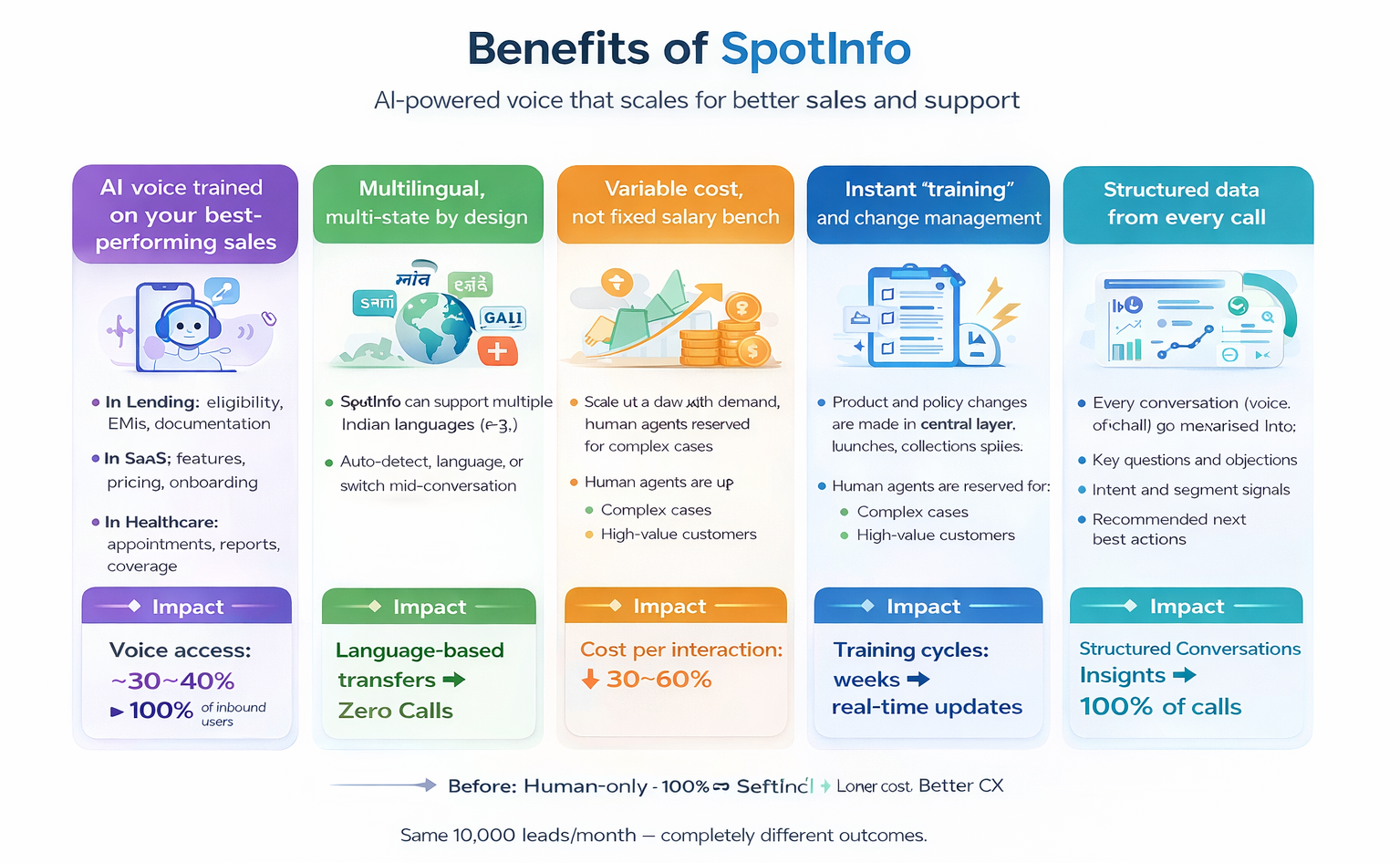
1. AI voice trained on your best-performing sales
Customers can call or tap-to-talk and have natural conversations about:
- Lending: eligibility, EMIs, documentation, AA/bank statement steps.
- SaaS: features, pricing, integrations, onboarding.
- Healthcare: appointments, procedures, reports, coverage.
The system is grounded in your:
- Product documentation
- Policies and compliance rules
- Sales scripts and workflows
Impact
- Voice access: ~30-40% -> 100% of inbound users
- Every lead/ customer can have a real-time conversation at the exact moment of doubt, without queue bottlenecks.
2. Multilingual, multi-state by design
- SpotInfo supports all Indian languages through multilingual speech and NLU stacks.
- It can auto-detect language, or let users choose, and switch mid-conversation if the user changes language.
Impact
- Language-based transfers -> Zero
- One AI layer can serve multiple geographies and language segments without multiplying headcount.
3. Variable cost, not fixed salary bench
Instead of scaling via hiring, SpotInfo scales with demand:
- Handles spikes (campaigns, launches, collections)
- Adapts to low-volume periods without idle cost
- Keeps human agents focused on high-value work
- Complex cases
- High-value customers
- Edge complaints and nuanced negotiations
Impact
- Cost per interaction: down 30-60%
4. Instant "training" and change management
Product and policy changes are applied once in the central system.
The AI reflects updates immediately across all conversations:
- No retraining cycles
- No lag between change and execution
- No dependency on agent learning curves
Impact
- Training cycles: weeks -> real-time updates
- Customers in any industry get consistent, up-to-date answers from day one
5. Structured data from every call
Each interaction, voice or chat is automatically analyzed for:
- User intent and segment
- Key questions and objections
- Recommended next-best actions
This transforms conversations into usable data for:
- Product teams (feature gaps, confusion points)
- Risk teams (intent signals, edge cases)
- Marketing (conversion drivers, objections)
Impact
- Structured Conversations Insights -> 100% of calls
- Conversations converted into structured insights (intent, objections, next steps)
- Enables continuous improvement across product, risk, and marketing
Accuracy, Trust, and Compliance Considerations
Introducing AI into customer conversations raises valid concerns around accuracy, trust, and compliance, especially in regulated or high-stakes environments.
Key risks include:
- Incorrect or outdated responses if the system is not grounded in the latest policies
- Over-generalisation or ambiguity in complex scenarios
- Regulatory exposure in industries like finance, insurance, or healthcare
To address this, systems like SpotInfo are designed with:
- Grounded responses based strictly on approved knowledge bases, policies, and workflows
- Controlled conversational boundaries, avoiding unsupported or out-of-scope answers
- Continuous monitoring and feedback loops to improve accuracy over time
- Human fallback mechanisms for uncertain or high-risk interactions
The goal is not to replace oversight, but to combine automation with control and guardrails.
When implemented with the right guardrails, this results in more consistent, auditable, and policy-aligned communication than purely human-driven systems.
In many cases, the risk is not introducing AI, but continuing with inconsistent, human-only communication at scale.
What different industries can aim for
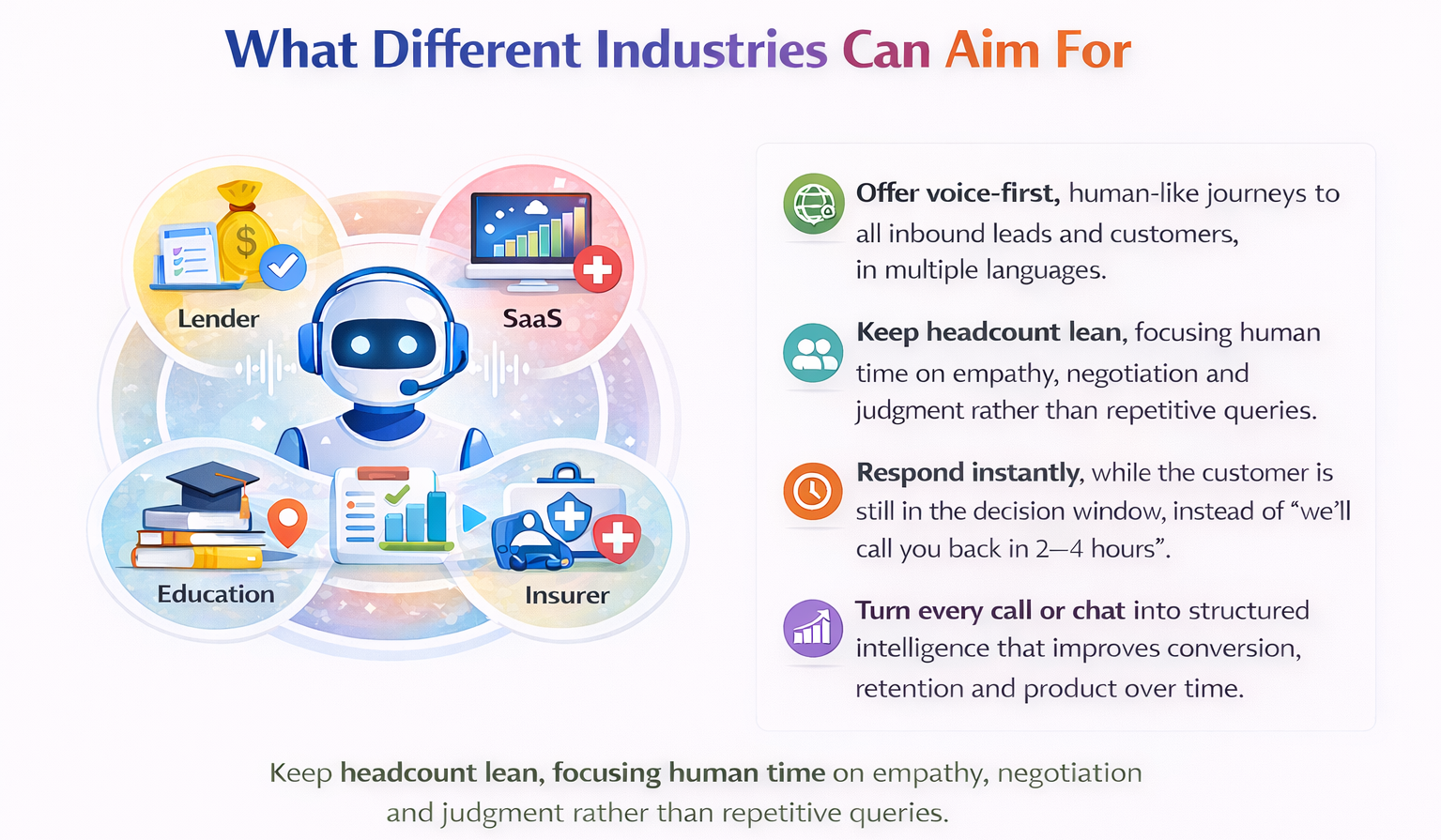
With SpotInfo in the stack, a lender or SaaS company, hospital, insurer, logistics provider can:
- Offer voice-first, human-like journeys to all inbound leads and customers, in multiple languages.
- Keep headcount lean, focusing human time on empathy, negotiation and judgment rather than repetitive queries.
- Respond instantly, while the customer is still in the decision window, instead of "we'll call you back in 2-4 hours".
- Turn every call or chat into structured intelligence that improves conversion, retention and product over time.
Lending is just one case study.
The underlying problem: "voice converts, but headcount doesn't scale" is the same across industries. SpotInfo is built to solve that once, and reuse the solution everywhere.
The constraint was never voice.
It was how voice was delivered.
When voice becomes software, the tradeoff disappears.